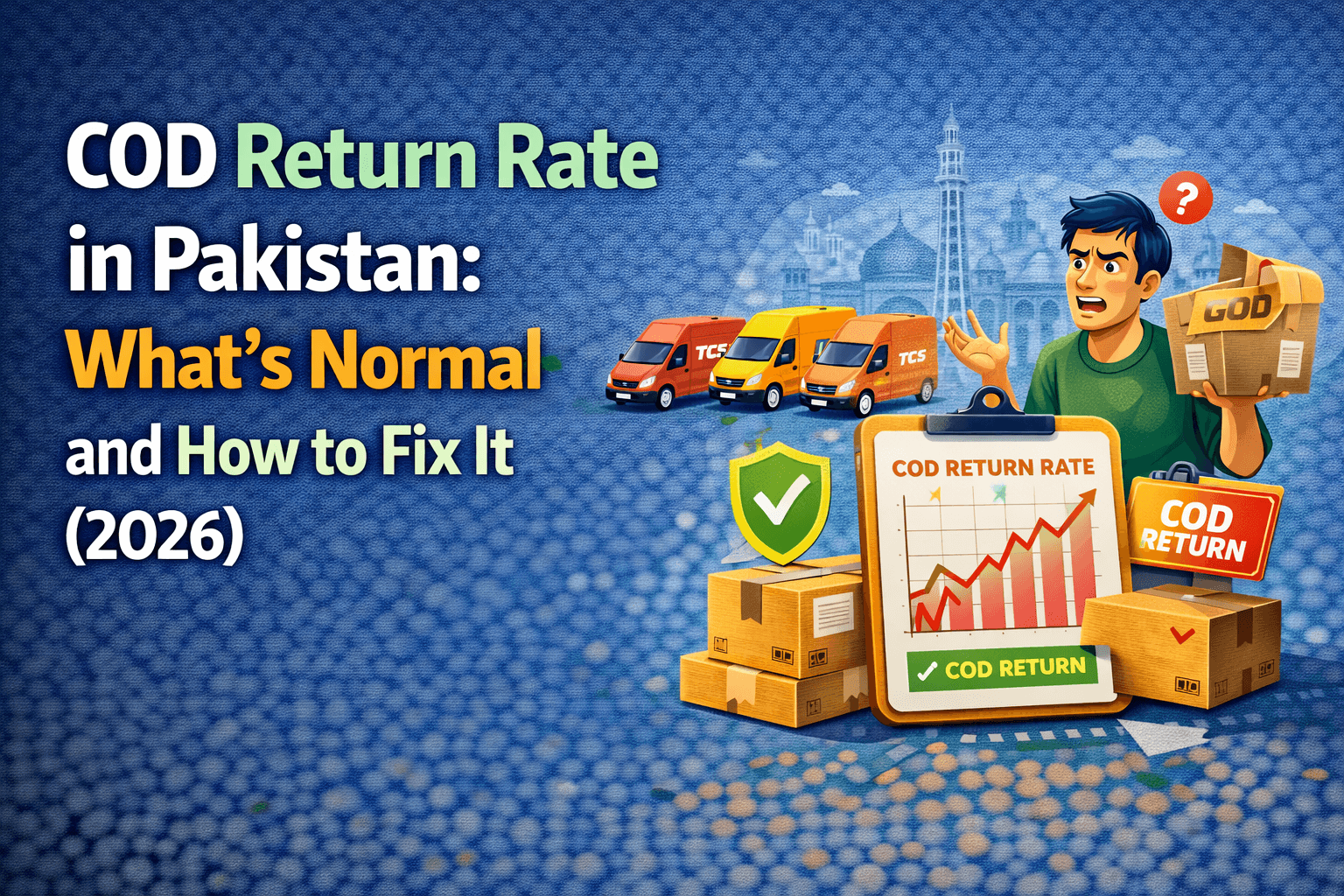
Every Pakistani Shopify store owner has experienced this. You check your courier dashboard on a Monday morning and realize 30 out of your last 100 orders came back undelivered. That's Rs. 30,000+ in wasted shipping costs before you've even thought about the lost sales, blocked inventory, and time spent managing returns. But is 30% actually bad? Is it normal for Pakistan? And what number should you actually be targeting? This guide answers all of that — what's a healthy COD return rate for a Pakistani store, what causes a high one, and the exact steps to bring it down.
Why COD Makes Pakistan's Return Rate Problem Unique
Before benchmarking your numbers, it's important to understand why Pakistan has a structurally higher return rate than most markets.
Cash on Delivery remains the backbone of online shopping in Pakistan, accounting for over 80% of eCommerce transactions. This is not going away anytime soon. COD builds trust with first-time buyers who are reluctant to pay online — and in Pakistan, that's still a large proportion of shoppers.
But COD carries an inherent problem: unlike prepaid orders where the customer has already invested money, COD orders require zero upfront commitment. The barrier to ordering is low, and so is the barrier to refusing.
Cash on delivery also produces problems including delayed cash settlements, fake orders, and high chances of Return to Origin (RTO) rates, where customers decline to accept the delivery.
So when comparing your return rate to global benchmarks, keep this context in mind. A 10% return rate in the UK is normal for prepaid ecommerce. A 10% return rate in Pakistan on COD orders is genuinely exceptional performance.
What's a Normal COD Return Rate for Pakistani Shopify Stores?
There is no single official figure for Pakistan specifically, but based on industry data from comparable COD-heavy markets and what Pakistani merchants report in practice, here's a realistic picture:
| Performance Level | RTO Rate | What It Means |
|---|---|---|
| Excellent | Under 10% | Very well-optimised — strong order verification, proactive tracking communication |
| Good | 10–20% | Healthy — some room to improve but not bleeding margin |
| Average | 20–30% | Common for most Pakistani stores — significant room to fix |
| High | 30–40% | A real problem — costing you serious money every week |
| Critical | Above 40% | Urgent — your COD operation needs a complete overhaul |
The industry average RTO rate for COD orders hovers between 20–35%. For some categories like fashion and electronics, it can exceed 40%.
Most Pakistani Shopify stores that haven't actively worked to optimise their COD process land somewhere in the 25–35% range. If you're in that zone, you're not alone — but you're also leaving a lot of money on the table.
The 6 Main Causes of High Return Rates in Pakistan
Understanding which type of RTO you're experiencing is the first step to fixing it. Different causes need different solutions.
-
Impulsive orders with no real commitment The 3–5 day gap between ordering and delivery gives customers time to reconsider. They might have found a better deal, changed their mind, or simply forgotten they ordered. Staff Ping A customer who placed a COD order at midnight during a Facebook ad scroll-through has very different commitment levels from one who spent 20 minutes browsing your store.
-
Fake and prank orders Roughly 8–10% of COD orders are outright fraudulent. Dondy Competitors, pranksters, or simply people testing your store place orders with no intention of accepting delivery. Without any verification step, you ship these and pay double freight for nothing.
-
Customer unavailability at delivery The rider arrives at 2pm, the customer is at work or sleeping, nobody answers — and after two failed attempts the parcel gets marked RTO. This is not the customer cancelling deliberately — they just weren't notified the parcel was coming that day. This is one of the most preventable causes of RTO.
-
Incorrect or incomplete address Wrong house number, missing lane name, incorrect city — any of these cause failed delivery. Many COD refusals happen because of address errors that could easily be caught with a simple confirmation step before dispatch.
-
Cash not available at delivery The customer genuinely wanted the order but didn't have the exact cash amount ready when the rider arrived. This is more common with higher-value orders. The rider can't wait, delivery fails, and it becomes an RTO.
-
Product didn't meet expectations The customer received the product, it looked different from the photos or didn't fit, and they refused it at the door. This is harder to fix through logistics — it requires better product photography and honest descriptions.
How to Calculate Your Actual RTO Rate
Before fixing anything, you need to know your real number. Here's the formula: RTO Rate = (Returned Orders ÷ Total Shipped Orders) × 100
For example: if you shipped 500 orders last month and 140 came back, your RTO rate is 28%.
Track this monthly and break it down by:
Courier — is one courier returning more than others? Product category — are certain products getting refused more? City — are certain cities generating higher RTO? Customer type — are first-time buyers returning more than repeat customers?
This breakdown tells you exactly where to focus your fixes.
5 Proven Fixes for Pakistani Shopify Stores
Fix 1 — Confirm every COD order via WhatsApp before dispatch This is the single highest-impact action you can take. Brands that implement WhatsApp COD confirmation within 5 minutes of order placement see RTO rates drop from 30–35% to 18–22% within the first month.
Send a simple message immediately after order placement: "Assalam o Alaikum [Name]! Aap ka order confirm ho gaya hai. Please reply YES to confirm ya NO to cancel. Amount: Rs. [X] | Item: [Product Name]"
Customers who don't respond within 12–24 hours are flagged before you've spent a rupee on shipping. Fake orders, impulsive orders, and wrong-number orders are filtered out automatically.
Fix 2 — Send an "Out for Delivery" WhatsApp update every time The most preventable cause of RTO — customer unavailability — is solved entirely by one message. When your TCS, Leopards, M&P, or PostEx parcel goes out for delivery, your customer should get a WhatsApp notification telling them their order is on the way today and how much cash to keep ready.
The Track My Order Shopify app does this automatically — the moment your courier marks a parcel "Out for Delivery", your customer gets notified without you doing anything. This alone significantly reduces missed delivery attempts. Read more about how automated tracking updates work in our guide on stopping WISMO messages on your Shopify store.
Fix 3 — Verify the delivery address before dispatch For every order — especially new customers — send a quick WhatsApp before handing it to the courier: "Please confirm your delivery address: [address from order]. Reply YES to confirm or send your correct address."
This eliminates every RTO caused by a wrong or incomplete address. Takes 30 seconds per order and has an outsized impact on your delivery success rate.
Fix 4 — Blacklist repeat refusers If a customer has placed COD orders and failed to confirm or refused delivery multiple times, automatically block them from COD or require prepaid payment only.
Keep a simple log in your Shopify customer notes or a Google Sheet. Any customer who has refused twice or placed fake orders gets flagged — either call them before dispatching their next order, disable COD for their account, or require a small advance payment.
Fix 5 — Incentivise prepaid orders Since prepaid orders generally show much lower RTO rates compared to COD — 4–8% vs 20–30% — incentivising prepaid can create a meaningful shift.
You don't need to remove COD. Just make prepaid more attractive:
Free shipping on prepaid orders 5–10% discount for advance payment Priority dispatch for prepaid orders
Even converting 20% of your COD volume to prepaid dramatically reduces your overall exposure. For a full breakdown of RTO reduction strategies, read our guide on how to reduce return rate on your Shopify store.
The Cost of Doing Nothing
Let's make this concrete. Say your store ships 400 orders a month at an average order value of Rs. 2,000, with a 30% RTO rate — that's 120 returned orders.
At Rs. 300 wasted per returned order in double shipping charges alone, that's Rs. 36,000 lost every month — Rs. 432,000 a year. Before accounting for blocked inventory, repackaging time, or lost sales.
Bringing that RTO rate from 30% down to 15% — entirely achievable with the fixes above — saves you Rs. 18,000 per month. That's real money that goes straight back to your bottom line.
Frequently Asked Questions
Start Fixing Your Return Rate Today
A high COD return rate is not inevitable — it's a fixable problem. Start with the two highest-impact actions: WhatsApp order confirmation before dispatch, and automated "Out for Delivery" notifications through the Track My Order Shopify app.
These two steps alone can bring a 30% RTO rate down to 15–18% within the first month — recovering tens of thousands of rupees in wasted shipping costs every single month going forward.